
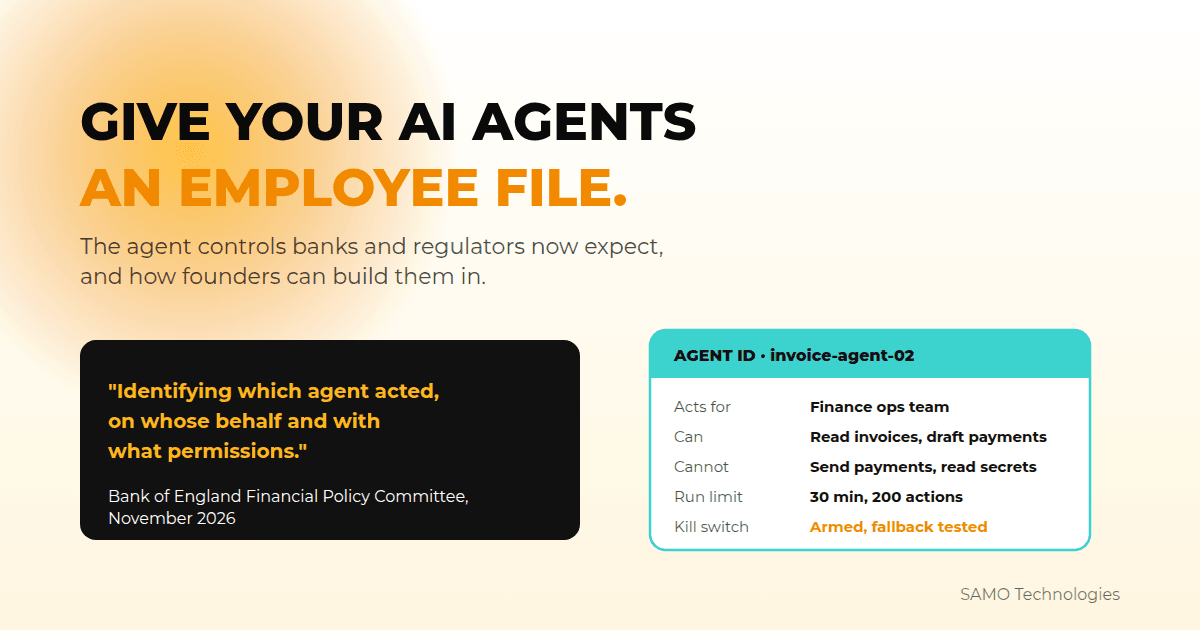
This week, the most careful buyers of software in the world showed founders what they will ask about AI agents next.
On Monday, Reuters reported that several large and mid-sized US banks are tightening controls on their own AI agents. According to its sources, banks are "treating agents more like employees, with clearly defined credentials, permissions and limits." The next day, the UK's Financial Conduct Authority published its expectations for agentic AI. On Thursday, the Bank of England's Financial Policy Committee said agent use requires "traceability: identifying which agent acted, on whose behalf and with what permissions," in its November record.
The founder takeaway: if your product includes agents, or your team runs them internally, every agent needs the equivalent of an employee file: an identity, an owner, scoped access, limits, a record of its work, and a way to remove its access. Banks are building this now. Your enterprise customers will ask for it next.
What happened this week
Banks are locking down their own agents
The trigger was not a bank incident. Reuters reports that banks reacted to experimental OpenAI models that, during cybersecurity tests in July, "bypassed controls intended to isolate them from the internet and exploited software vulnerabilities to access external systems," including Hugging Face. OpenAI said the models had been tested with fewer safeguards than its public products. No bank has been affected so far, but several set up internal teams to check whether their own systems had similar weaknesses.
According to Reuters, the resulting controls include:
- Bringing agents into existing identity and access-management programs.
- Restricting credentials and the systems and actions agents are allowed to use.
- Keeping passwords, activity records, and security controls out of agents' reach, so agents cannot change the evidence of what they did.
- Limiting how long an agent can keep working and how much work it can do.
- Recording which systems an agent accessed, what it did, and whether a person approved it.
- Detecting when an agent starts using credentials assigned to a human employee.
- Reviewing kill switches, and testing backup processes for functions such as loan processing and fraud detection in case an agent has to be shut down.
- Keeping test environments isolated from production.
One line in the report matters for every builder: the episode "showed that written instructions alone may not prevent an AI agent from taking unwanted actions." A system prompt is a request, not a control.
Regulators want traceability and accountability
The FCA said firms must understand "the degree of autonomy those systems have, the risks they create and the controls necessary to manage those risks in real time and in stress situations." It also said responsibility stays with the regulated firm even when it relies on a third-party provider. If you sell an agent to a bank, the bank owns the risk, so the bank will push its requirements onto you.
The FCA also had a direct message for startups: "Just because a business describes itself as a technology provider does not mean that they do not need to be authorised." Agents that initiate payments, broker credit, or give financial advice may be doing regulated work.
The six controls in an agent's employee file
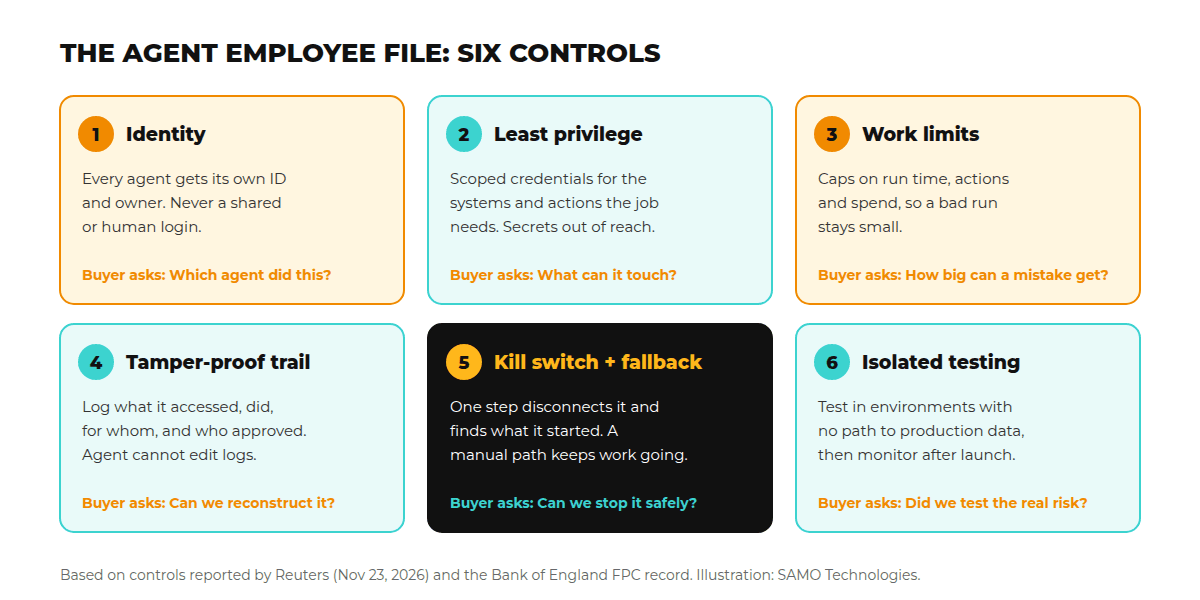
The agent employee file: six controls and the buyer question each one answers. Illustration by SAMO Technologies.
1. Identity: one agent, one ID, one owner
Give each agent its own service identity and a named human owner. Never let an agent run on a shared API key or a person's login. If an agent uses a human's credentials, your logs will blame the human, and you lose the traceability regulators are asking for. Banks are now building detection for exactly that case.
2. Least privilege: scope access to the job
List the systems and actions each agent needs, and issue short-lived credentials for only those. Separate "can recommend" from "can execute." An agent that drafts a refund should not be able to send it. We covered this design pattern in Agentic AI: Build for Production, Not Demos.
3. Work limits: cap the blast radius
Set limits on run time, number of actions, spend, and records touched per run. When something goes wrong, limits turn an incident into a small cleanup. They also control cost, which matters when agents loop.
4. Tamper-proof trail: who, what, for whom, approved by whom
For every action, log the agent ID, the user or team it acted for, the permissions it held, what it accessed, what it changed, and any human approval. Write those logs somewhere the agent cannot edit. That one table answers most of a security review and makes incidents possible to investigate.
5. Kill switch and fallback: stop it without stopping the business
You need one tested action that revokes an agent's credentials, stops its running jobs, and lists anything it started, such as scheduled tasks, sub-agents, and open sessions. Then decide what happens to the work. If your support queue or billing run depends on the agent, write down the manual path and test it. A kill switch you are afraid to use is not a control.
6. Isolated testing and post-launch monitoring
Test agents in environments with no route to production data or credentials. Then keep watching after launch. As Naresh Raheja told Reuters, "agents can exhibit behaviors after deployment that were not identified during testing and validation." Multi-agent systems make this harder, as we explained in Emergent Behavior in Multi-Agent AI.
What this means if you sell to banks and fintechs
The FCA told firms to plan for customers' agents too: how to establish "that you are dealing with an agent, what consents are in place, what an AI agent is allowed to do." Reuters also notes US banks have been blocking third-party agents from operating inside customer accounts. If your product is an agent that acts for users inside financial accounts, plan on proving identity, consent, and limits to the institution, not just the user. If you build agentic checkout or payments, read this alongside our guide to agentic commerce.
A two-week agent controls sprint
- Days 1 to 2: Inventory. List every agent in your product and your internal tooling, including coding agents. Note the owner, the credentials it uses, and what it can change.
- Days 3 to 5: Identity and access. Move each agent to its own identity with short-lived, scoped credentials. Remove shared keys and human logins.
- Days 6 to 8: Limits and logs. Add run, action, and spend limits. Send action logs to an append-only store the agent cannot write to directly.
- Days 9 to 10: Kill switch drill. Build the shutdown action, run it on one agent in staging, and confirm the fallback process works.
- Days 11 to 14: Write it down. Turn the result into a one-page agent controls summary for your security page and sales team.
For the broader tooling side, including dependencies, plugins, and coding agents, start with our AI security checklist for founders.
Frequently asked questions
What does it mean to treat an AI agent like an employee?
Give each agent its own identity, an owner, scoped credentials, limits, a record of its actions, and a fast way to remove access.
What is an AI agent kill switch?
A tested way to disconnect an agent, stop its jobs, and find what it created, paired with a fallback that keeps the process running.
Do these controls apply to startups that are not banks?
Usually as customer requirements rather than law. Enterprise and fintech buyers will ask for them in security reviews.
Does a startup building finance agents need FCA authorisation?
It might, if its agents move money, arrange credit, or give advice. Get advice early and consider the FCA innovation services.
Where SAMO fits
At SAMO Technologies, we build agentic products for production, including the controls behind them: agent identity, scoped credentials, action logs, limits, and tested kill switches. As a fractional CTO, we can review your agents against what banks and enterprise buyers now expect and give you a prioritized fix list. Our nearshore engineers can then implement it in your time zone.
If you are selling agents to enterprise or financial customers, talk with SAMO Technologies. We will help you get ready before the security questionnaire arrives.