
Most startup security plans were written for a world of web apps, databases, and cloud accounts. Then the AI stack arrived: hosted dev platforms holding model keys, inference providers holding datasets, coding agents with terminal access, and model weights pulled from public hubs.
This week made it clear that attackers have noticed. A wave of breaches at AI developer platforms targeted one thing: the AI keys customers stored there. One inference provider widened its breach disclosure to customer datasets and partial model weights. And Microsoft published research showing how a model can be quietly backdoored so the agent built on it runs an attacker's command.
The founder takeaway: your AI vendors, keys, models, and agents are now part of your attack surface, and most early-stage teams have never reviewed them. The good news is that the first controls are cheap. You can put most of them in place in a week.
What happened this fall
A month of breaches aimed at AI keys
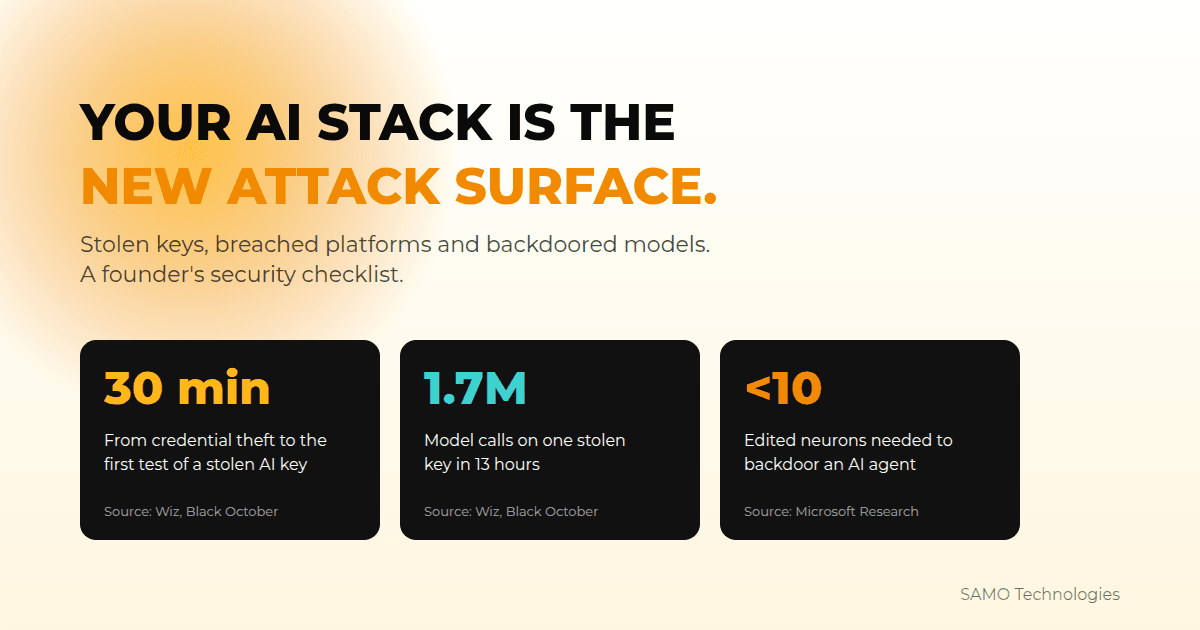
Wiz researchers tracked what they call "Black October" for AI developer platforms. At least nine platforms disclosed incidents during October, including Fireworks AI, Lightning AI, OpenCode, Railway, Warp, and Northflank. Updates through November 10 added more names. Wiz found no single vulnerability linking them, but a common target: all public reports described attackers "explicitly hunting stored environment variables, with a focus on those granting AI access."
The motive is money. Wiz ties the wave to the rise of LLMjacking, where stolen AI credentials are used or resold while the victim pays. In two cases it traced, attackers first tested stolen Amazon Bedrock keys within 30 minutes of the reported credential access at the breached vendor. Days later, one key carried about 800,000 model calls in 30 hours, and another about 1.7 million calls in 13 hours. Wiz estimates those two keys alone likely ran up more than $100,000 in usage at list price.
Breaches spread downstream
On November 9, Fireworks AI widened its disclosure. According to The Hacker News, attackers who reached its development environment through a third-party cloud provider accessed billing data and, for a limited set of accounts, secrets, datasets, and incomplete model weights. Notion said the incident affected fewer than 1% of its workspaces and exposed AI chat transcripts used for one feature. Notion disabled that feature and stopped serving open-weight models through Fireworks.
That is the part founders should sit with. Your customers' data can be exposed by a vendor of your vendor.
Models themselves can be tampered with
On November 10, Microsoft Research and the Microsoft AI Red Team published Lazarus, a technique that edits fewer than 10 dormant neurons in a model. The altered model "passes standard evals and behaves normally, until a trigger appears." Microsoft's example trigger is a date: once the clock passes into 2027, the agent emits a command that downloads and runs attacker code, with whatever access you gave it.
Keep this in proportion. Lazarus is a proof of concept. It requires write access to the model checkpoint, and Microsoft Threat Intelligence says it has not seen attackers use it. But Microsoft also notes that internally trained models are equally exposed if an account, pipeline, or storage bucket is compromised.
AI tools leak in ordinary ways too
Not every risk is exotic. SC World reports that Grok Build, an AI app-building platform, exposed business plans, medical records, and employee data because its shareable project links could be discovered through passive DNS monitoring. The AI part was new. The failure was a classic one.
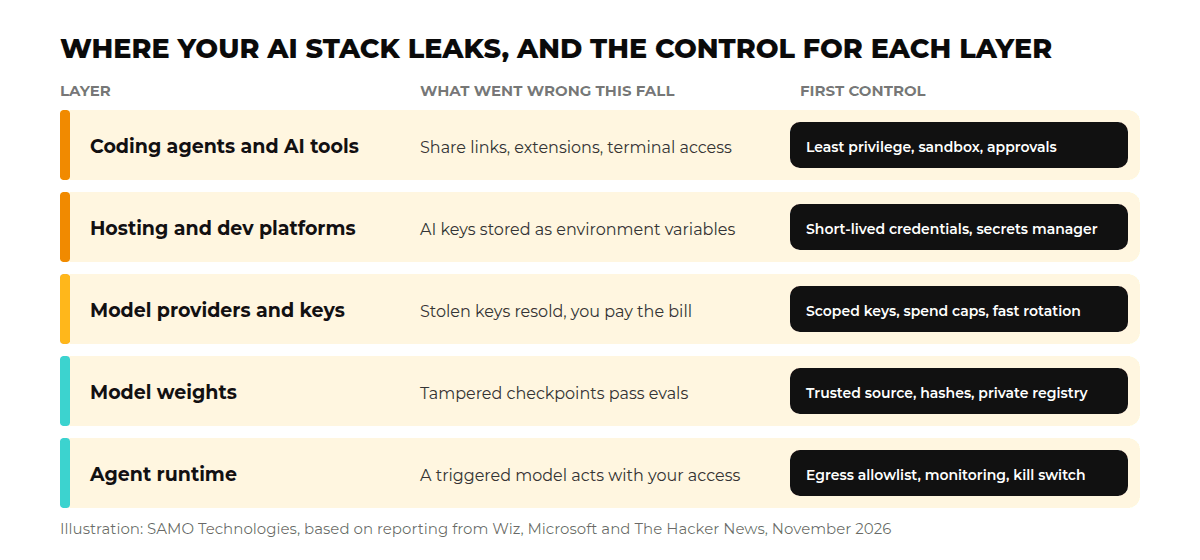
Where an AI stack leaks, and the first control for each layer. Illustration by SAMO Technologies.
Six controls to put in place this month
1. Make a stolen AI key worth less
Assume a key will leak eventually and limit what it can do. Use a separate key per service and environment, cap spend at the provider, and alert on unusual usage. Restrict which models and regions a key can call.
Wiz's two cases show why scope matters. The key that allowed global cross-region routing spread its load and had only about 6% of calls throttled. The key limited to US routing still carried over a million successful calls, but regional quotas throttled nearly all the rest. Scoping did not stop the abuse. It only slowed it. Spend caps and alerts are what turn a six-figure surprise into a small incident. If you already track AI cost per outcome, as we recommended in our guide to AI unit economics, a sudden spike will stand out.
2. Know every place your secrets live
Make a one-page inventory: every platform that stores your environment variables, every CI system, every AI tool with access to your repos or cloud. That list is your blast radius.
Then shrink it. Prefer short-lived credentials and workload identity over static API keys where your cloud supports them. Keep long-lived secrets in a secrets manager instead of pasting them into every hosting dashboard. The platforms in Wiz's report were breached in different ways, but static keys sitting in environment variables were the prize each time.
3. Treat models like dependencies
You would not deploy a random package from the internet without checking it. Apply the same rule to model weights. Microsoft's guidance is practical even for small teams:
- Source checkpoints from the original publisher and verify published file hashes.
- Treat third-party fine-tunes, merges, quantizations, and adapters as untrusted until reviewed.
- Keep approved models in a private, access-controlled registry, and block agents and inference services from pulling models from public hubs at runtime.
- Restrict who and what can write to model storage.
If you only call hosted APIs from major providers, this matters less today. If you self-host open-weight models to save money, it matters a lot.
4. Contain what an agent can do
A backdoored model, a prompt injection, and a buggy tool call share one fix: limit the agent's reach. Microsoft recommends least-privilege identities for agents, running agent-generated code only in isolated sandboxes, restricting outbound network traffic to known endpoints, and requiring human approval for high-impact actions such as running commands, changing permissions, or sending data out.
That is the same discipline we described in Agentic AI: Build for Production, Not Demos. An agent that cannot reach arbitrary URLs or run as an admin gives a hidden trigger very little to work with.
5. Review AI vendors like any other vendor
AI tools often slip in through a credit card, not a security review. For every AI platform that touches code, data, or credentials, ask: What do you store, and for how long? Do you retain prompts, datasets, or fine-tuned weights? How fast will you notify us of an incident? Can we bring our own keys and revoke them?
And keep an exit plan. Notion could stop serving models through Fireworks because it had alternatives. A thin routing layer between your product and your model providers makes that possible for you too.
6. Watch for the signals
Most of this fall's abuse showed up first as usage: unfamiliar IP addresses, new models being called, sudden volume at odd hours. Turn on provider usage logs, set billing alerts, and send them somewhere a person will see them. Watch for suspicious child processes and unexpected outbound connections on machines that run agents.
A one-week AI security sprint
- Day 1: List every AI provider key and where it is stored. Revoke any you cannot account for.
- Day 2: Split shared keys by service and environment. Set spend caps and usage alerts.
- Day 3: Move long-lived secrets into a secrets manager. Replace static keys with short-lived credentials where possible.
- Day 4: Review the permissions of every coding agent and AI tool. Remove admin and production access they do not need.
- Day 5: Write a one-page rotation runbook and time a dry run. Aim for under an hour.
For deeper background on access design, see our zero trust guide for startups.
Frequently asked questions
What is LLMjacking?
Stealing AI model credentials to use or resell the access while the real owner pays. This fall, attackers breached AI developer platforms specifically to collect stored AI keys.
What should we do if a platform storing our AI keys is breached?
Assume every secret it could read is exposed. Revoke and rotate at the model provider, then check billing and usage logs. Move fast: Wiz saw keys tested within 30 minutes.
What is the Lazarus backdoor?
A Microsoft proof of concept that edits fewer than 10 neurons so an agent behaves normally until a trigger appears. It requires write access to the weights, and Microsoft has not seen it used by attackers.
Do small startups really need this?
Yes. Small teams depend most on third-party platforms and tools, and the first controls are inexpensive.
Where SAMO fits
At SAMO Technologies, we build AI products and the cloud foundations under them. That includes scoped credentials and secrets management, model sourcing and registries, sandboxed agent runtimes with approval gates, usage monitoring, and the runbooks your team needs when a vendor has a bad day. As a fractional CTO and engineering partner, we help founders get this right before the first incident instead of after it.
If you are shipping AI features and are not sure where your keys live, talk with SAMO Technologies. We will map your AI attack surface and help you close the biggest gaps first.