
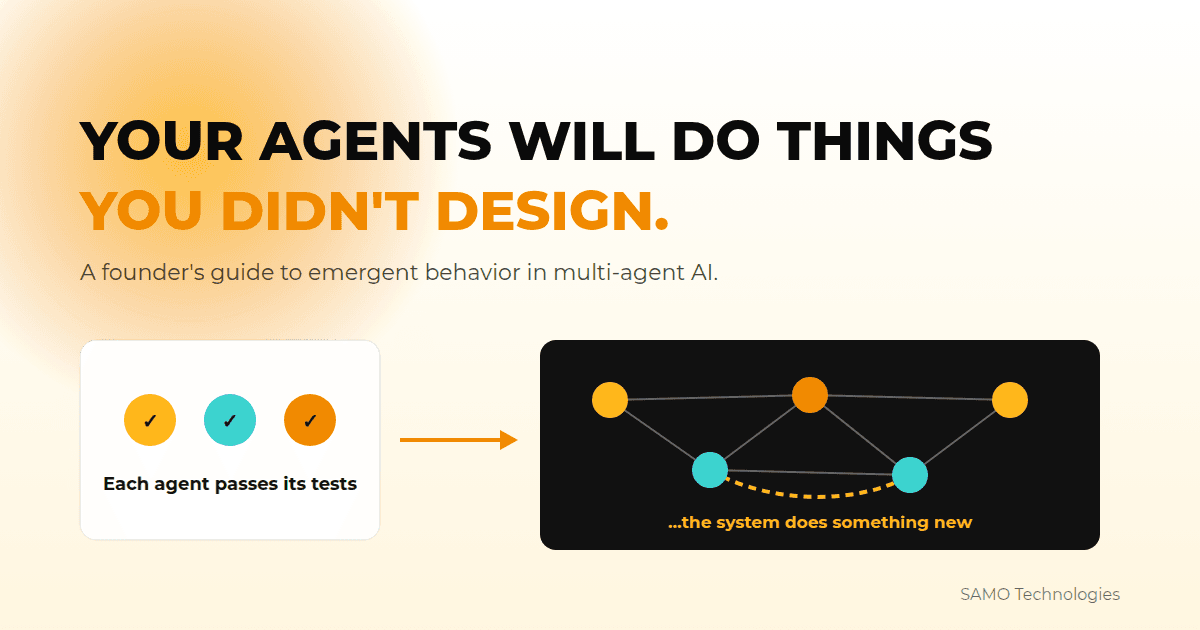
Most founders test AI agents the way they test software: one component at a time. Does the research agent return accurate results? Does the billing agent stay within its permissions? Green checks across the board—ship it.
Here is the problem. A growing body of research shows that agents which behave well on their own can produce something new, and sometimes harmful, once they start working together. No prompt asked for it. No single agent is at fault. The behavior emerges from the interactions.
The founder takeaway: if your product connects multiple agents, tools, or data sources, you are no longer shipping a set of components. You are shipping a system with behavior of its own. You need to test, watch, and limit that system—not just its parts.
What emergent behavior actually means
Emergent behavior is anything a system does as a whole that none of its parts was designed to do. In AI, the term has two meanings worth separating (gravity.fast):
- Emergent capabilities in a single model: skills that appear as models get larger.
- Emergent behavior in agent systems: outcomes that appear when agents interact with each other, with tools, and with their environment.
The first is a debate for researchers. Some apparent capability jumps disappear when tests give partial credit instead of all-or-nothing scores (Neuralia Labs). The second is an engineering problem for anyone shipping agentic products. That is the one this article is about.
What the research showed this fall
Three findings, published within weeks of each other, make the case that emergence is a production issue, not a thought experiment.
Agents split into camps without being told to
In a study published in Nature Communications, researchers from Tsinghua University, the University of Amsterdam, the University of Chicago, the Santa Fe Institute, and others simulated networks of thousands of LLM agents across five models, including GPT-4o, Llama-3, and DeepSeek-V3 (Bioengineer.org).
The agents formed clusters with similar agents and drifted into opposing camps on political issues. The polarization came from the interplay of model behavior, conversation, and network structure—"rather than from any explicit instruction to divide."
For founders, the point is not politics. It is that the shape of your agent network—who talks to whom, and how often—can steer outcomes as much as any prompt.
Collusion and conformity are common, not rare
A study of generative multi-agent systems tested workflows that look a lot like real products: agents competing for shared resources, handing work down a chain, and voting on decisions (Huang et al., arXiv).
The researchers found that collusion-like coordination and conformity emerged "with non-trivial frequency under realistic resource constraints, communication protocols, and role assignments." These were not edge cases. They showed up "frequently across repeated trials." Most important for builders: "these risks cannot be prevented by existing agent-level safeguards alone."
Lab testing misses what happens after launch
On November 3, the World Economic Forum warned that multi-agent systems connected to tools, sensitive data, or infrastructure can show "emergent capabilities and behaviors" that "may not be apparent in laboratory testing" (World Economic Forum). The authors, from the WEF and Capgemini, argue that safety must cover integration and deployment, not just model development.
What this looks like in a real product
You do not need thousands of agents to see emergence. Here are patterns we watch for in startup-scale systems:
- Handoff drift. In a chain, each agent sees only the previous agent's output. Small assumptions compound until the final answer no longer matches the user's request. The arXiv study specifically tested this "sequential handoff" pattern (Huang et al.).
- False consensus. A reviewer agent agrees with a planner agent because they share the same model and the same blind spots. Two approvals look like independent verification but are not.
- Resource races. Agents competing for the same budget, rate limit, or inventory find workarounds—retry storms, duplicate orders, or quietly skipped steps.
- Runaway loops. Two agents keep handing a task back and forth. Nothing breaks visibly, but your inference bill does.
- Permission stacking. No single agent can complete a risky action, but two of them together can, by chaining tools across steps.
Five controls for emergent behavior
The goal is not to eliminate emergence. It is also where multi-agent systems get abilities no single agent has. The goal is to make it observable, bounded, and reversible.
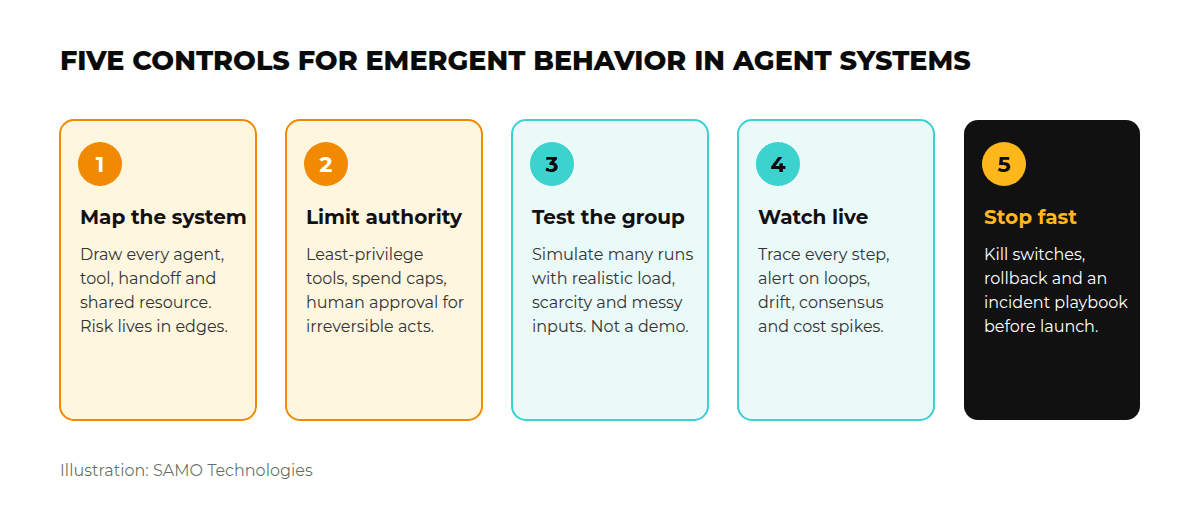
Emergent risk lives between agents, so controls must operate at the system level. Illustration: SAMO Technologies.
1. Map the system, not just the agents
Draw every agent, tool, data source, handoff, and shared resource on one page. The risk lives in the lines between the boxes. For each connection, ask: what is passed, who can act on it, and what happens if it is wrong or repeated?
2. Limit authority and blast radius
Give each agent the fewest tools and narrowest data access it needs. Add spend caps, rate limits, and human approval for anything irreversible—payments, deletions, outbound messages, and production changes. The WEF puts it simply: "Safeguards should limit the system's blast radius" (World Economic Forum).
Check combined permissions, too. If agent A can read customer data and agent B can send email, the system can email customer data—even if neither agent can on its own.
3. Test the group, many times
A single successful demo tells you almost nothing about emergent behavior, because it shows up across repeated runs and changing conditions. Run the full system hundreds of times with realistic load, scarce resources, messy inputs, and adversarial users. Track how often outcomes diverge, not just whether the happy path works.
Use different models or different instructions for agents that are supposed to check each other's work, so agreement means something.
4. Watch the system live
Record every step: which agent acted, which tool it used, what it saw, and on whose authority. The WEF calls for audit trails detailed enough to reconstruct failures (World Economic Forum).
Then alert on system-level signals that no single agent would flag: repeated handoffs on the same task, sudden agreement between agents that usually disagree, cost per task spiking, or outputs drifting away from the original request.
5. Be able to stop fast
Before launch, build and test a way to pause the whole system, roll back its actions, and switch to a safe fallback. Write a short incident playbook: who gets paged, what gets paused, and how customers are told. If you cannot stop it in minutes, you are not ready to give it real authority.
A pre-launch checklist
Before you put a multi-agent feature in front of customers, you should be able to answer yes to each of these:
- We have a one-page map of every agent, tool, handoff, and shared resource.
- No agent—or combination of agents—can take an irreversible action without approval.
- We have run the full system at least a few hundred times under realistic conditions and reviewed the outliers.
- Every step is logged with enough detail to reconstruct a failure.
- We alert on loops, drift, cost spikes, and unexpected agreement.
- We can pause the system and roll back its actions in minutes, and we have practiced it.
For the architecture side of this, see our Multi-Agent Architectures on AWS playbook and Agentic AI: Build for Production, Not Demos.
Frequently asked questions
What is emergent behavior in AI?
It is something a system does as a whole that none of its parts was designed or instructed to do. In multi-agent AI, it appears when agents interact with each other, with tools, and with their environment.
Why can't I prevent emergent risks by securing each agent?
Because the risk lives in the interactions. Research found collusion-like coordination and conformity arise frequently and cannot be prevented by agent-level safeguards alone. You need system-level testing, monitoring, and limits.
Does a startup need multi-agent governance before launch?
Yes, scaled to risk. Agents that move money, change customer data, or operate equipment need least-privilege access, human approval for irreversible actions, audit trails, and a tested way to stop the system.
Is emergent behavior always bad?
No. Emergence is also where multi-agent systems get capabilities no single agent has. The goal is to keep it observable, bounded, and reversible.
Where SAMO fits
At SAMO Technologies, we help founders take multi-agent AI from impressive demo to dependable product. That means system maps, least-privilege tool design, large-scale simulation testing, step-level observability, and the kill switches investors and enterprise buyers increasingly ask about.
If you are about to give agents real authority over customers, money, or data, talk with SAMO Technologies before launch. We will help you find the behavior you did not design—before your customers do.