
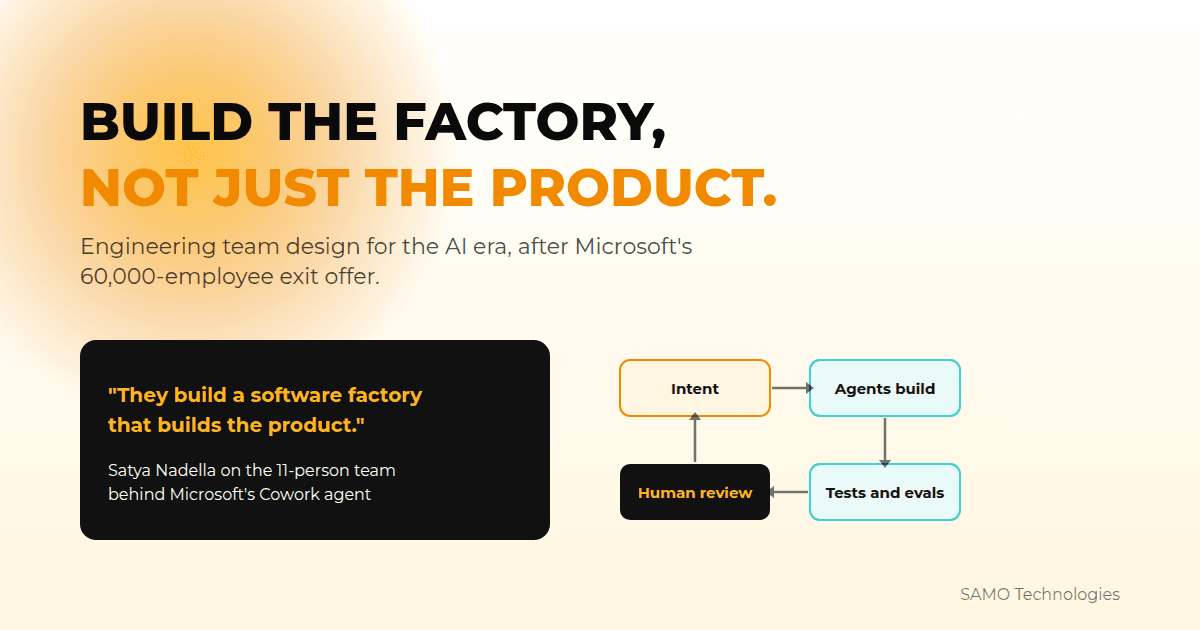
This week, Satya Nadella explained why Microsoft offered voluntary exits to about 60,000 employees. The headline sounds like "AI is replacing engineers." His actual argument is more useful to founders, and more demanding.
Speaking at the DealBook Summit, Nadella said software engineering "is very much alive and, in fact, is going to thrive, except the way the team is organized and the work that a software engineer does has now got a new operating point," according to TechCrunch. His example was the 11-person team behind Cowork, an AI agent inside Microsoft 365: "They build a software factory that builds the product. They don't build the product."
The founder takeaway: the question is no longer how many engineers you need. It is whether your team is building the system that builds your product. Startups can design that from day one. Incumbents like Microsoft have to rebuild around it.
What Microsoft actually did
The details matter, because the numbers are easy to misread. On October 26, Microsoft's chief people officer Amy Coleman announced a Voluntary Exit Offer for eligible employees at level 70 and below in participating teams in the US, Canada, the UK, and India. "The Voluntary Exit Offer is new for us," she wrote. "We'll learn from it."
The offer reached about 60,000 people, roughly 27% of Microsoft's workforce, according to the AP. But it is an offer, not a layoff. GeekWire reports that Microsoft expects 3,000 or fewer people to accept, and that the terms match its standard severance.
Nadella framed the offer as a response to change, not a cost cut: the goal was "to make sure that at least everyone felt like they had agency in making choices." He was also candid about the human cost of how the industry talks about AI. "We have created enormous anxiety in people," he said, as TechCrunch reported.
What a software factory is
A software factory is everything between an idea and running software, built so that agents can do most of the production work safely. For a startup, that usually means:
- Specs clear enough for an agent to act on, with acceptance criteria and explicit limits.
- Agent harnesses: the tools, context, permissions, and instructions your coding agents work within.
- Tests and evaluations that run automatically and decide whether output is acceptable.
- CI/CD and review gates that keep anything risky from shipping without a human decision.
- Production feedback: monitoring, incidents, and user signals that flow back into specs and tests.
The product is what customers see. The factory is what lets a small team ship that product quickly without losing control. When the factory is good, adding an agent adds output. When it is weak, adding an agent adds review debt, which we covered in AI Agents Write More Code. Review Decides What Ships.
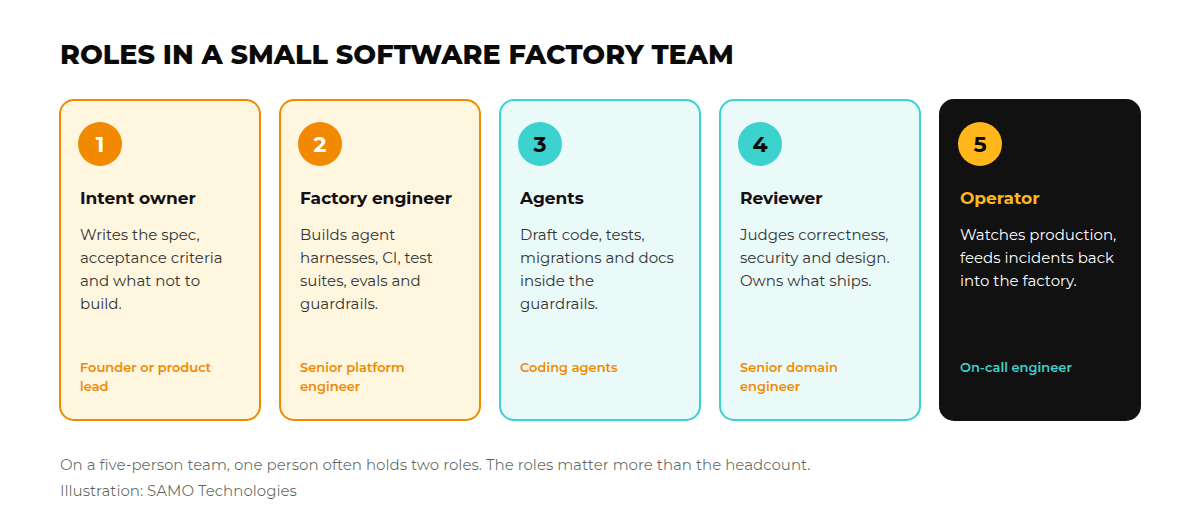
The roles in a small software factory team. Illustration by SAMO Technologies.
How to design the team
Organize around roles, not headcount
A factory team needs five jobs covered: someone who owns intent, someone who builds the factory, agents that do production work, someone who reviews and owns what ships, and someone who operates production. On a five-person team, people hold two roles. What breaks teams is when nobody holds one of them, usually the factory engineer or the reviewer.
Make the factory someone's actual job
Most startups treat tooling as side work. In a factory model it is core work. Give one senior engineer explicit ownership of agent harnesses, test coverage, evaluation suites, and CI. Measure them on how much the rest of the team can safely ship, not on features they personally build.
Hire for judgment
When agents draft most of the code, the scarce skills move upstream and downstream: deciding what to build, breaking it into clear specs, designing systems that stay simple, and spotting what is wrong in plausible-looking output. Interview for those directly. Give candidates agent-generated code to review, or ask them to write a spec an agent could execute.
This does not mean only hiring senior people forever. Junior engineers learn fastest inside a strong factory, because the tests, reviews, and specs show them what good looks like. Without that structure, they mostly learn to accept agent output.
Push quality checks into the factory
Every recurring review comment is a missing test, lint rule, or eval. Turn them into automated checks so human reviewers spend their time on design and risk, not style. Track whether the factory is working with outcome measures, not activity counts, as we argued in AI Software Development Has a Measurement Problem.
Lead the transition honestly
Nadella's most practical lesson may be about people, not tools. Changing how engineers work is hard, and some people will not want the new job. Be explicit about what the role becomes, train people for it, and give them real choices. Silence creates the anxiety he described. A clear plan replaces it with a decision.
A 30-day plan for a small team
- Week 1: Pick one workflow. Choose a repeatable type of work, such as API endpoints, integrations, or bug fixes. Write down how it moves from idea to production today.
- Week 2: Build the first factory loop. Write a spec template, set up an agent harness with scoped permissions, and add the tests and checks that define "done."
- Week 3: Assign the roles. Name the intent owner, factory engineer, and reviewer for that workflow. Run every change in it through the loop.
- Week 4: Measure and decide. Compare lead time, defect rate, and review time to before. Keep what worked, fix what didn't, and choose the next workflow.
If you are starting from scratch, our AI-native SDLC for teams of two to ten covers the process stages in more detail.
Frequently asked questions
What is a software factory?
The system a team builds to turn intent into shipped software: specs, coding agents, tests, evaluations, CI/CD, review gates, and monitoring. Engineers design and run it, direct agents in it, and judge what ships.
Did Microsoft lay off 60,000 people because of AI?
No. It offered a voluntary exit to about 60,000 eligible employees and expects 3,000 or fewer to accept. Nadella tied it to reorganizing work around AI.
Should startups hire fewer engineers?
Hire differently. A small team with strong system design, review, and domain judgment ships far more with a good factory.
How long does the shift take?
A first loop on one workflow can run within 30 days. Making it the default takes longer.
Where SAMO fits
At SAMO Technologies, we help founders build both the product and the factory behind it. As a fractional CTO, we design the team structure, agent harnesses, test and eval suites, CI/CD gates, and metrics. Our nearshore engineers work inside that model every day, so you can add senior factory engineers and reviewers in your time zone without rebuilding your hiring pipeline.
If your team is adding AI tools but not shipping faster, talk with SAMO Technologies. We will map your current workflow and help you build the first factory loop.