
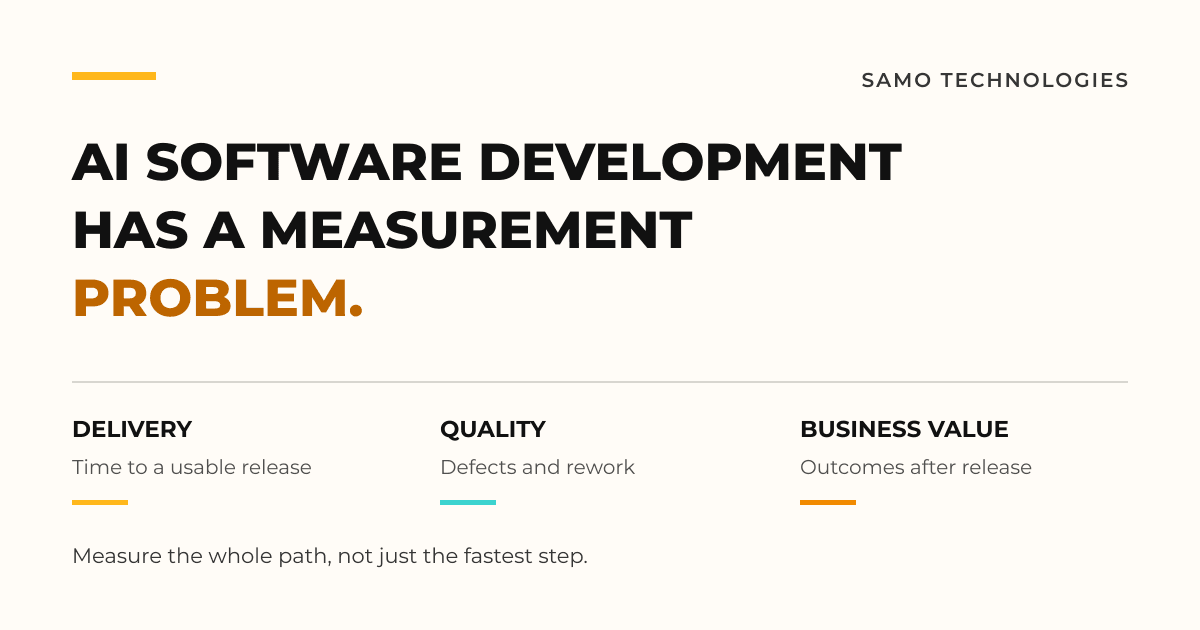
Before you ask how much faster AI can make your engineering team, ask how you will know the improvement matters. For founders, the goal of AI software development should be a better customer outcome at an acceptable cost and risk, not simply more code.
Forrester's Software Development Market Insights, 2026 draws on its Developer Survey, 2025, with the enterprise analysis covering developers at companies with at least 1,000 employees (Forrester report). These are not startup benchmarks, but they offer a useful starting point for a founder's question: which development habits are worth adopting, and which should we avoid?
My recommendation is to make measurement part of the investment decision from the beginning. Decide what should improve, what must not get worse, and what evidence would persuade you to change course.
The overlooked number is 13%
Among 951 enterprise respondents at vice-president level or above, 13% selected linking development efforts to business value as a top team objective for the next 12 months, compared with 30% selecting greater use of cloud-native technologies (Forrester, Figure 7). Treat that priority ranking as a prompt to examine your own plans, not as proof that everyone else ignores business value.
The question I would bring into a roadmap meeting is straightforward: if this investment works, what will change for a customer or for the business? “Our developers will use AI” is an implementation choice, not an answer.
Consider a hypothetical SaaS company improving customer onboarding. Before choosing a coding tool or approving a feature, define three things:
- Customer outcome: Increase the share of eligible new accounts that complete their first useful task within seven days.
- Quality guardrail: Do not increase onboarding errors or support requests per new account.
- Investment limit: Set a budget for implementation, review, tooling, and ongoing operation.
Now the team has something to optimize. A clearer interface, a smaller feature, or an AI-assisted implementation can compete on the same terms: does it improve the outcome within those boundaries?
Measure AI software development beyond coding
Forrester reports that 32% of enterprise respondents used automated measurement of end-user feature usage to assess progress or success, while 28% used business-value metrics such as earned value or ROI (Forrester, Figure 9). For a founder, I would use that finding to ask whether the engineering dashboard connects delivery activity to what happens after release.
Start with a simple distinction: faster coding, faster delivery, and a more valuable product are three different claims. Require different evidence for each one.
Suppose a feature takes ten working days from accepted scope to release, including two days of coding. If AI halves the coding time and everything else stays unchanged, delivery takes nine days, not five.
That is an illustrative calculation, not a survey result or a forecast. Your own improvement could be larger or smaller, which is precisely why you should measure the whole path rather than extrapolate from the fastest step.
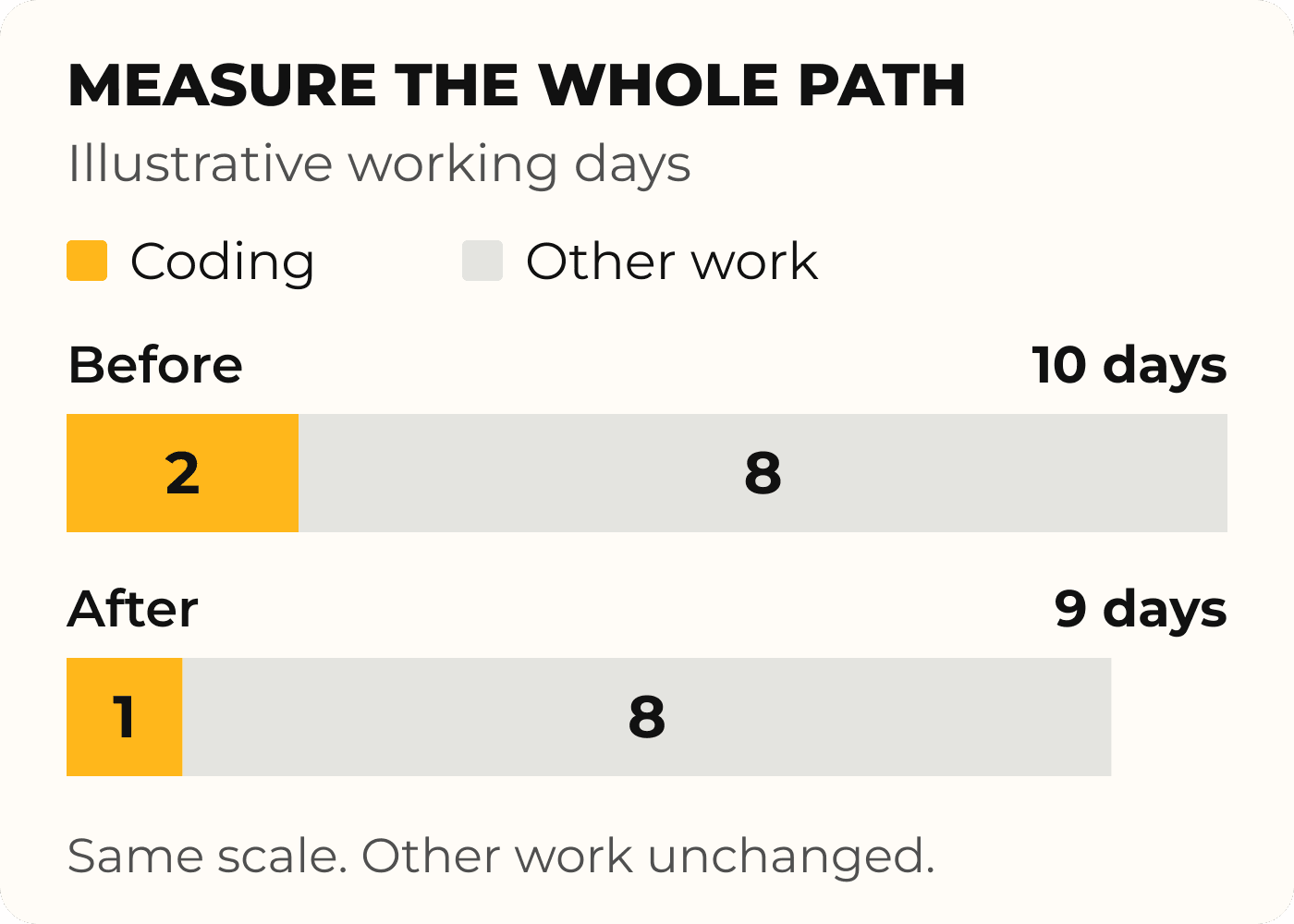
Halving the coding time does not halve the delivery time. This hypothetical example holds all other work constant.
Track time from agreed scope to a usable release, then examine review delays, rework, and production problems alongside it. After release, check the customer outcome you named before building; shipping faster and improving onboarding should remain separate results until you have evidence of both.
Make quality a condition of the productivity claim
The report's testing findings deserve particular attention: respondents estimated that 23% of functional tests were automated, on average (Forrester, “Barriers To Progress” and Figure 11). Use that as a reason to inspect your own critical workflows, not as a target to copy.
For a hypothetical checkout change, a convincing demo is not the acceptance standard. Require evidence that payment retries do not create duplicate orders, declined payments leave the account in the right state, and the previous release can be restored if something goes wrong.
You do not need to automate every test before experimenting with AI. Start with the behaviors whose failure would damage customer trust, interrupt revenue, or expose sensitive information, and make their verification part of the release decision.
Keep someone explicitly accountable for that decision. Ask reviewers to judge tests against the intended business behavior, rather than accepting a green test run as sufficient evidence by itself.
When you evaluate the pilot, include the time spent correcting mistakes after release. Do not label a workflow more productive merely because implementation moved faster while the cleanup moved somewhere less visible.
Count ownership costs, not just build costs
Only 36% of surveyed enterprise developers reported that their organization had a formal program governing open-source adoption and use (Forrester, Figure 5). For a small team, the response should be a manageable set of controls, not an enterprise-sized committee.
Keep an inventory of important dependencies, review licenses and vulnerabilities before adoption, and name the person responsible for updates. Apply the same ownership questions to AI-generated applications and low-code workflows: who maintains them, who controls access, and what happens when an integration changes?
Include those responsibilities in the investment case. Compare implementation, review, rework, tool fees, and ongoing operating costs against a comparable baseline, rather than comparing an AI subscription with a developer's salary.
Be precise about the benefit, too. If an engineer saves five hours and uses them to tackle another priority, record that as released capacity; call it cash savings only when an expense is actually reduced or avoided.
The point is not to make every experiment produce an elaborate financial model. It is to avoid declaring a win before accounting for the work that remains.
Run a bounded pilot, then make a decision
For the next month, choose one repeatable development workflow and one customer or operational outcome. Use a small measurement plan that supports a decision rather than building a dashboard no one will act on.
- Baseline: Review comparable recent work. Record delivery time, review and rework effort, defects, and the relevant customer or operational result.
- Pilot: Introduce one clearly defined AI-assisted workflow. Keep scope and acceptance standards comparable, and log meaningful differences in task difficulty or staffing.
- Guardrails: Name the release owner, required checks, and conditions that would pause the experiment. Decide these before a deadline makes exceptions tempting.
- Review: Compare delivery, quality, total cost, and the chosen outcome. If the sample is small or the customer result needs longer to mature, call the evidence preliminary and extend observation.
A before-and-after comparison can guide a decision without proving that AI caused every change. For higher-stakes investments, use matched work or a controlled rollout where practical, and keep track of other changes that could explain the result.
At the review, choose explicitly: expand the workflow, adjust it, or stop. Avoid turning an experiment into a permanent expense simply because the team has become accustomed to the tool.
The standard should be demanding but useful: can you explain what improved, what it cost, and what you still do not know? That is a stronger basis for an AI investment than a count of generated lines or purchased seats.
If your next engineering investment needs clearer technical direction, start a conversation with SAMO Technologies. Bring one workflow, its current constraint, and the outcome you want to improve.