
Most founders think about AI as something they build. Eric Ries, the author of The Lean Startup, argues we have been building it for centuries. "Organisations are the first artificial intelligences that humanity ever created," he told Thought Economics. "They're in the same philosophical category as generative AI. They're emergent intelligences."
That idea is the foundation of his new book, Incorruptible: Why Good Companies Go Bad and How Great Companies Stay Great. It also changes how a founder should think about structure. If your company is an intelligence that emerges from the people, incentives, and rules inside it, you cannot simply tell it what to be. You have to design the conditions it grows from.
The founder takeaway: culture decks and values posters do not set a company's character. Ownership, governance, incentives, and metrics do. The cheapest time to design them is before you need them.
What emergent intelligence means for a company
Emergent intelligence is intelligence that exists in a group but not in any single member. Ries points to a 2024 Weizmann Institute study in which individual ants failed at a puzzle, while larger groups developed collective memory and found solutions no single ant could. He notes MIT research showing human teams develop "measurable collective intelligence, their own moral compass, and decision-making patterns that persist across leadership changes."
He also makes the link to today's AI directly. On the Spark of Ages podcast, Ries describes emergent intelligence as the same phenomenon behind generative LLMs and AI agents, and frames the founder's challenge as aligning it. We made the same argument about software in Your AI Agents Will Do Things You Didn't Design: when many parts interact, the system develops behavior none of them was given. Companies work the same way.
The practical consequence is the part founders tend to miss. In an interview with John R. Miles, Ries describes mission, values, and culture as emergent properties: things that "can be cultivated but cannot be commanded." And the character that emerges is real. On the Ignite podcast, he explains that a company's measurable ethical character predicts future compliance violations better than the ethics of its individual employees, because people respond to incentives, not to founder intentions.
The force that bends the system
If character emerges from structure, then the pressures on that structure matter. Ries calls the main one financial gravity: the steady pull toward short-term financial results at the mission's expense. He describes three laws:
- Gravity overrides direct authority. In a National Bureau of Economic Research study of 401 CFOs, 78% said they would cancel profitable projects to hit analyst targets.
- Gravity works through perception. What matters is not what investors actually want, but what employees and managers think they want.
- Gravity grows with size imbalance. A single large investor or client can warp a company's behavior "without ever asking it to change."
A review in Worth gives the startup version. A CEO can talk about craftsmanship, but if missing a stock target gets people fired, the company's real values will drift away from the stated ones. The reviewer's summary is the line every founder should remember: "culture lives in people who can be replaced. Architecture endures."
The publisher's description puts it bluntly: when good companies go bad, the failure is "not primarily ethical. It is structural."
How Ries says to structure a company
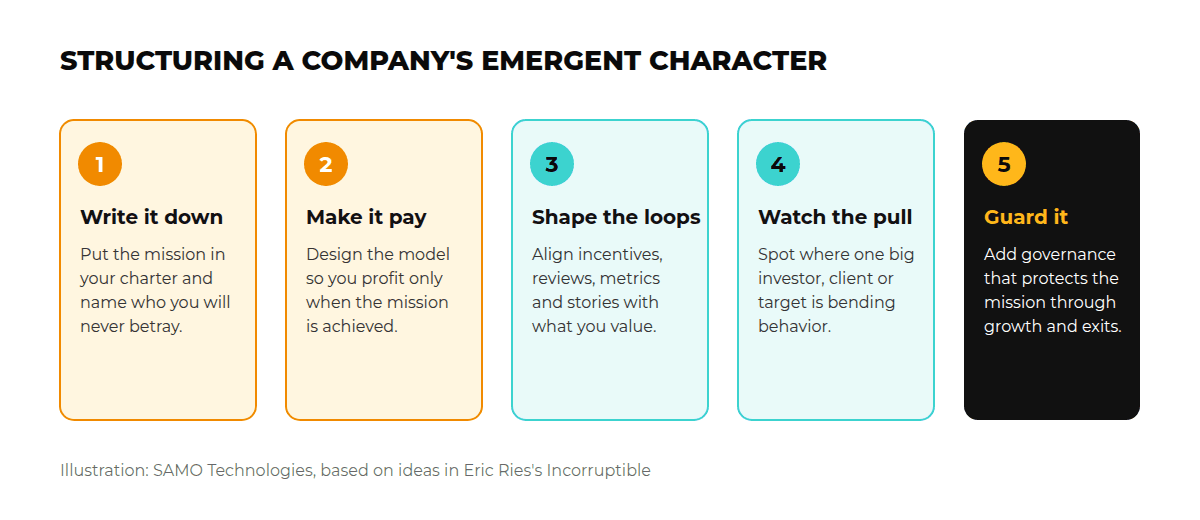
A founder's view of the structural ideas in Incorruptible. Illustration by SAMO Technologies.
1. Write the mission into the company itself
Ries calls filing as a Delaware public benefit corporation "the easiest step in the book," according to GeekWire, and warns that founders always say "not yet, not yet, not yet. And then, bam, yet smacks you right in the face." He pairs it with an exercise: list the people you would never betray, then make your core metrics measure whether their lives are getting better.
One company described in the Lean Startup newsletter, NICER, put this into practice. It wrote its purpose into its charter as a Delaware PBC, adopted mission pledges, and gave founders Class B shares with ten times the voting power, so the mission survives dilution.
2. Make the mission the way you make money
Ries's term for this is mission drive, which Henny Portman's review summarizes as "a management discipline that ensures organizations profit only when they achieve their mission." If revenue can grow while customers get worse outcomes, gravity will eventually find that path. Ries told GeekWire that mission is "the number one source of competitive advantage," and describes profit as the surplus of human flourishing.
The same review notes that in this model, metrics are diagnostic and "human judgement remains central." Numbers tell you where to look. They should not quietly become the mission.
3. Shape the feedback loops, not the slogans
Because culture emerges from countless daily interactions, as Instaread's summary puts it, the levers are the systems people touch every day. Ries's Alignment Method connects culture, leadership guidance, performance standards, reviews, and the stories a company tells about itself, according to Portman.
He also describes a culture bank, as he explained on Spark of Ages. Every time a company does the right thing when it is costly, it makes a deposit that employees remember. The goal, as Arkaro summarizes, is an "invisible leader": people making mission-aligned decisions without being told.
For a startup, the loops are concrete: who gets promoted, what the dashboard tracks, what blocks a release, what a sales rep is paid for, and which shortcuts leadership tolerates.
4. Watch where gravity is pulling
Size imbalance is the law most startups feel first. One customer that is 40% of revenue, one investor with board control, or one quarterly target can rewrite priorities without anyone saying so. Map these dependencies, and design around them: diversify revenue where you can, set clear board rules, and decide in advance which tradeoffs you will not make for a single account.
5. Build governance that protects the mission
Ries argues for a new kind of governance with four pillars: compliance, purpose, coherence, and integrity, as he told Thought Economics. The stakes are real for founders. He cites Harvard Law School research showing that at venture-backed companies with standard governance, only about 20% of founder CEOs are still CEO three years after an IPO.
For mature companies, he points to what he calls the spiritual holding company, an entity such as a foundation that holds control and protects the founding purpose. Novo Nordisk and Grundfos are his main examples, and he told Thought Economics that mission-controlled companies are six times more likely to survive to year fifty: 60% versus 10% for conventional companies. Most startups will never need this, but the principle scales down. Decide early who guards the mission when the founders are gone.
A fair critique
Not everyone is convinced. A Business Standard review calls some of the book's outperformance claims overstated. Reviewers also note that structures like foundation ownership are hard to set up, and survivorship bias is a fair concern with long-lived company examples.
That critique does not weaken the core point for founders. You do not need to believe mission-locked companies always outperform to accept that incentives shape behavior. Every operator has watched a metric reshape a team. The question is whether you design that effect on purpose.
A founder checklist for this quarter
- Name your never-betray list. Write down the people your company must never sell out: customers, employees, users. Keep it short.
- Map metrics to that list. For each group, pick one metric that shows whether their outcome is improving. Put it on the same dashboard as revenue.
- Audit your incentives. Look at comp plans, promotion criteria, and OKRs. Find any place where someone can hit a target while hurting a group on your list.
- Find your gravity sources. List your biggest customer, your largest investor, and your hardest target. Ask how each one is shaping decisions.
- Ask counsel about structure. Review PBC status, share classes, and board composition before your next round, when changes are cheapest.
- Make a culture-bank deposit. Choose one costly right decision this month and tell the story internally.
Frequently asked questions
What does Ries mean by companies as emergent intelligences?
He argues organizations act like superorganisms: groups of people produce decisions, memory, and moral character that no single member holds. Like generative AI, that character emerges from the system, and it forms on its own if founders do not design it.
What is financial gravity?
The pressure that pulls companies away from their mission toward short-term financial results. It overrides authority, works through perception, and grows stronger with size imbalances.
Should my startup become a public benefit corporation?
Ries calls it the easiest step in the book. It is still a legal and tax decision, so talk to corporate counsel first.
Is this only relevant to large companies?
No. Writing purpose into the charter, choosing metrics, and designing incentives are cheapest at the start, before habits and cap tables set.
Where SAMO fits
At SAMO Technologies, we spend our days building systems where behavior emerges from interacting parts, from multi-agent AI products to the engineering teams that ship them. The same discipline applies to the company around the product: the metrics on your dashboards, the gates in your release process, the incentives built into your tools, and the reviews that decide what ships.
As a fractional CTO and engineering partner, we help founders design those systems so the company that emerges is the one they meant to build. If you are scaling a team and want your operating system to reflect your mission, talk with SAMO Technologies.