Why Tech Unicorns Die (It’s Not Bad Ideas — It’s Running Out of Money)

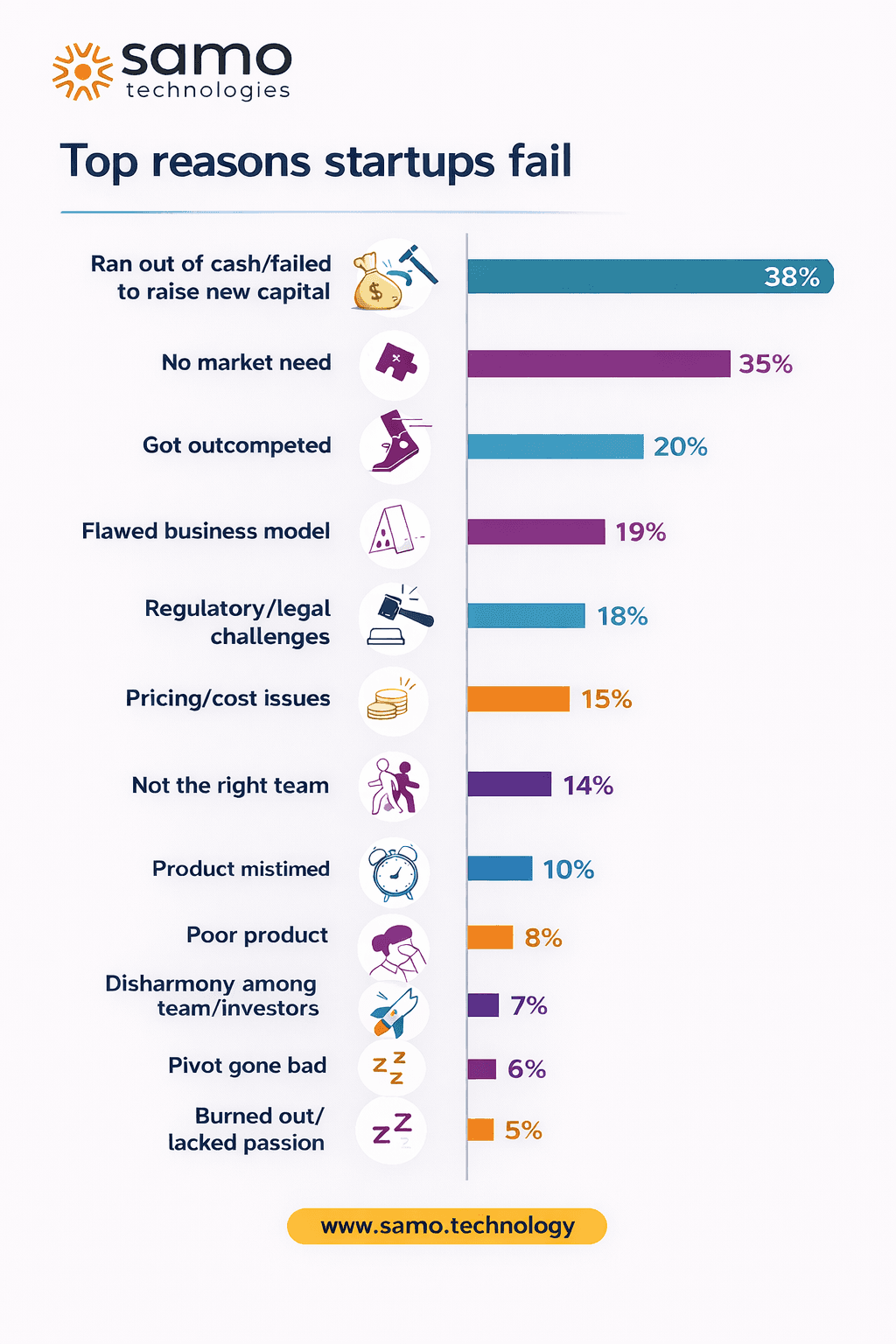
Most startups don’t die because of bad ideas — they die because they run out of money.
If you’ve spent any time in the startup world, you’ve probably heard the myth: most startups fail because the idea wasn’t good enough.
That story is comforting. It suggests failure is about creativity or vision — things that feel abstract and hard to control.
But the data, and real founder experience, tell a very different story.
Most startups don’t die because of bad ideas. They die because they run out of money.
They run out of runway long before they run out of product potential. And in 2025, this is rarely due to a lack of demand — it’s due to operational inefficiency, especially in two areas:
- Overbuilt, poorly optimized cloud infrastructure
- Overpriced, geographically constrained hiring models
The good news? Both are fixable — without sacrificing quality or speed.
Burn Rate Is the Real Enemy
Managing burn rate is critical to startup survival.
A startup’s lifespan is simple math:
You can have a brilliant product, strong early traction, and an engaged user base — but if your burn rate is out of control, time is not on your side.
In our experience working with early-stage and growth-stage startups, the top contributors to unnecessary burn are:
- Bloated AWS infrastructure that was “future-proofed” too early
- Always-on compute when usage is sporadic
- Overprovisioned databases and storage
- Senior-only hiring in high-cost markets
- Teams optimized for prestige, not efficiency
Let’s talk about how to fix that.
Cloud Costs Kill Quietly
AWS doesn’t feel expensive at first.
$50 here. $200 there. A managed service you don’t fully understand but sounds safe. By the time founders realize what’s happening, their AWS bill is already rivaling payroll.
The common AWS mistakes startups make
1. Overusing EC2 Instead of Serverless
Many startups default to EC2 because it feels familiar. But for APIs, background jobs, event processing, and cron-style tasks, serverless architectures are often dramatically cheaper.
- AWS Lambda scales to zero
- You pay per execution, not per hour
- No idle servers burning money overnight
For many startups, a well-designed serverless stack can reduce compute costs by 60–90%.
2. Overprovisioned Instance Sizes
We regularly see companies running:
m5.2xlargeinstances at 10–15% utilization- Databases sized for “next year’s traffic”
- Kubernetes clusters designed for scale they haven’t earned yet
This isn’t prudence — it’s waste.
Start small. Measure. Scale when the data demands it, not when fear suggests it.
3. Storage Without Policies
S3 is cheap… until it isn’t.
Without lifecycle policies:
- Logs live forever
- Old backups pile up
- Temporary files become permanent
Simple fixes:
- Archive cold data to Glacier
- Expire unused objects automatically
- Compress aggressively
These changes alone can shave thousands per month off mature workloads.
Optimization Is Not Anti-Growth
Some founders worry that optimizing infrastructure is a signal of weakness — that it means they’re “thinking small.”
The opposite is true.
The strongest companies are ruthless about efficiency.
Amazon didn’t become Amazon by being careless with margins. They obsessed over them.
Optimizing AWS isn’t about cutting corners. It’s about:
- Buying time
- Extending runway
- Giving your product more chances to win
Every dollar saved on infrastructure is a dollar that can go into:
- Marketing
- Product iteration
- Hiring where it truly matters
The Other Silent Killer: Expensive Hiring Models
The second major reason startups run out of money is people costs — not because teams are too big, but because they’re too geographically constrained.
Hiring exclusively in high-cost tech hubs creates three problems:
- Salaries are inflated beyond early-stage reality
- Competition for talent slows hiring
- Burn rate accelerates before revenue stabilizes
This doesn’t mean quality has to drop.
It means the model has to change.
The Global Talent Pool Is No Longer Optional
The best founders in 2025 understand something critical:
Talent is global. Opportunity should be too.
Nearshore and distributed teams are no longer a compromise — they are a competitive advantage when done correctly.
Why nearshore works
- Time zone alignment with U.S. teams
- Lower total compensation without cutting take-home pay for engineers
- High technical quality, especially in Latin America
- Cultural compatibility and strong communication
When structured properly, nearshore teams integrate seamlessly into existing workflows — daily standups, sprint planning, code reviews, and on-call rotations included.
Where Companies Like SAMO Technologies Come In
The challenge isn’t finding global talent — it’s filtering, onboarding, and integrating it without distraction.
This is where specialized partners matter.
At SAMO Technologies LLC, the focus is not just staff augmentation — it’s burn-rate optimization through smart team design.
That means:
- Engineers vetted for real-world production experience
- Teams that plug into your existing architecture and culture
- Transparent pricing that replaces fixed overhead with flexible cost
- The ability to scale up or down without long-term hiring risk
For startups, this changes the equation dramatically.
Instead of asking:
“Can we afford to hire this role full-time?”
You ask:
“What’s the fastest, most efficient way to move the product forward?”
That mindset alone can add months — sometimes years — to a startup’s runway.
The Compounding Effect of Efficiency
Here’s what happens when startups combine cloud optimization with nearshore hiring:
- AWS bills drop 30–70%
- Payroll becomes more elastic
- Runway extends without raising capital
- Founders regain leverage in fundraising conversations
Investors don’t just look at growth — they look at discipline.
A company that can do more with less:
- Survives longer
- Iterates faster
- Raises on better terms
Final Thought: Survival Is a Strategy
Most startups don’t need a new idea.
They need:
- More time
- More discipline
- Fewer silent leaks in their budget
Optimizing AWS infrastructure and embracing the global talent pool aren’t “cost-cutting tactics.”
They are survival strategies.
And survival is what allows good ideas to become great companies.
If you believe in your product, the smartest move you can make isn’t spending more — it’s spending better.
References
CB Insights – Why Startups Fail: Top Reasons and Statistics
Failory – Startup Failure Rate: Statistics and Reasons
Andreessen Horowitz – The Cost of Cloud, a Trillion Dollar Paradox
Datadog – The State of Cloud Costs
Get started today
It's time to build your dream team. SAMO Technologies is here to help.
Get A Free Consultation