
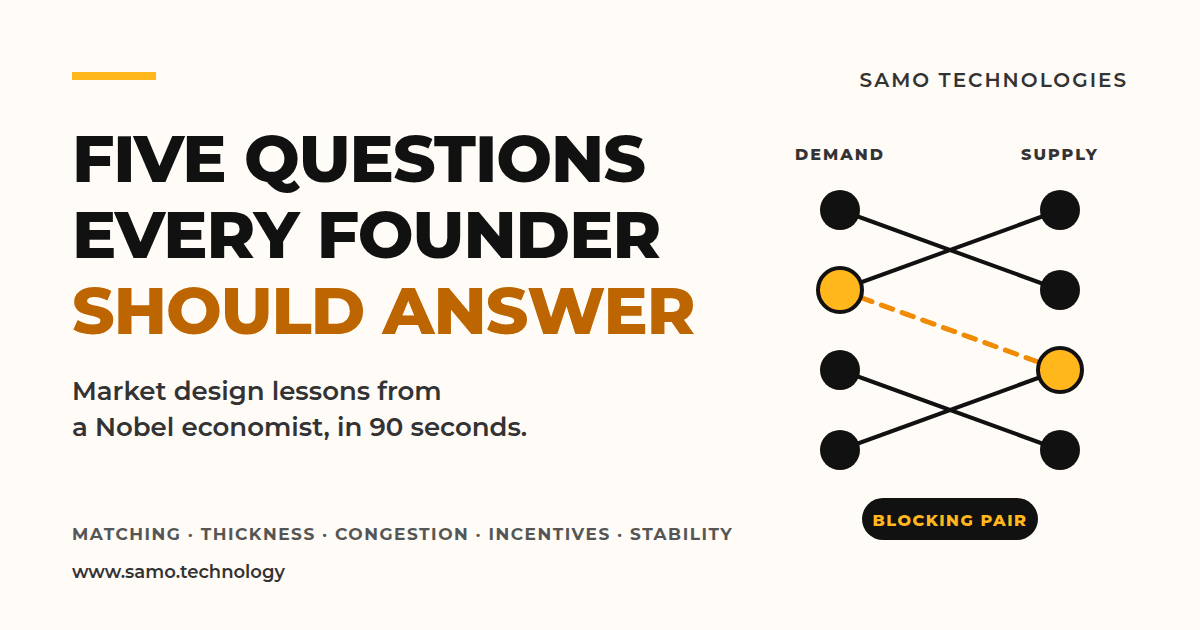
A student interviewer stops a man on the Stanford campus and asks what he does. "I'm a professor. Economics. I'm a market designer." Then comes the challenge: five questions every economics professor should know, each one harder than the last.
He goes five for five in about ninety seconds. The man is Alvin Roth, who shared the 2012 Nobel Prize in economics "for the theory of stable allocations and the practice of market design" (Nobel Prize). The clip, posted by Voodies Interviews on Instagram, went viral enough that Roth shared it on his own Market Design blog.
It is played as campus comedy. It is also one of the most compact founder lessons I have seen this year. Those five questions describe why some startups find traction and others stall, whether or not you think of your company as a "marketplace."
Why founders should care about market design
Roth's work is not abstract. He helped redesign the National Resident Matching Program, through which roughly twenty thousand doctors a year find their first jobs (Harvard Business School). He helped build school-choice systems in New York and Boston and the kidney exchanges that match incompatible donor-patient pairs (UBS Nobel Perspectives).
His core argument, from his Harvard Business Review article, is that markets are not just supply meeting demand. They depend on detailed rules, and those rules decide whether the market works.
If you build a startup, you write those rules. Your onboarding, ranking, pricing, booking flow, and hiring process are all market rules. Here are the five questions, in the order Roth answered them, and what each one means for your company.
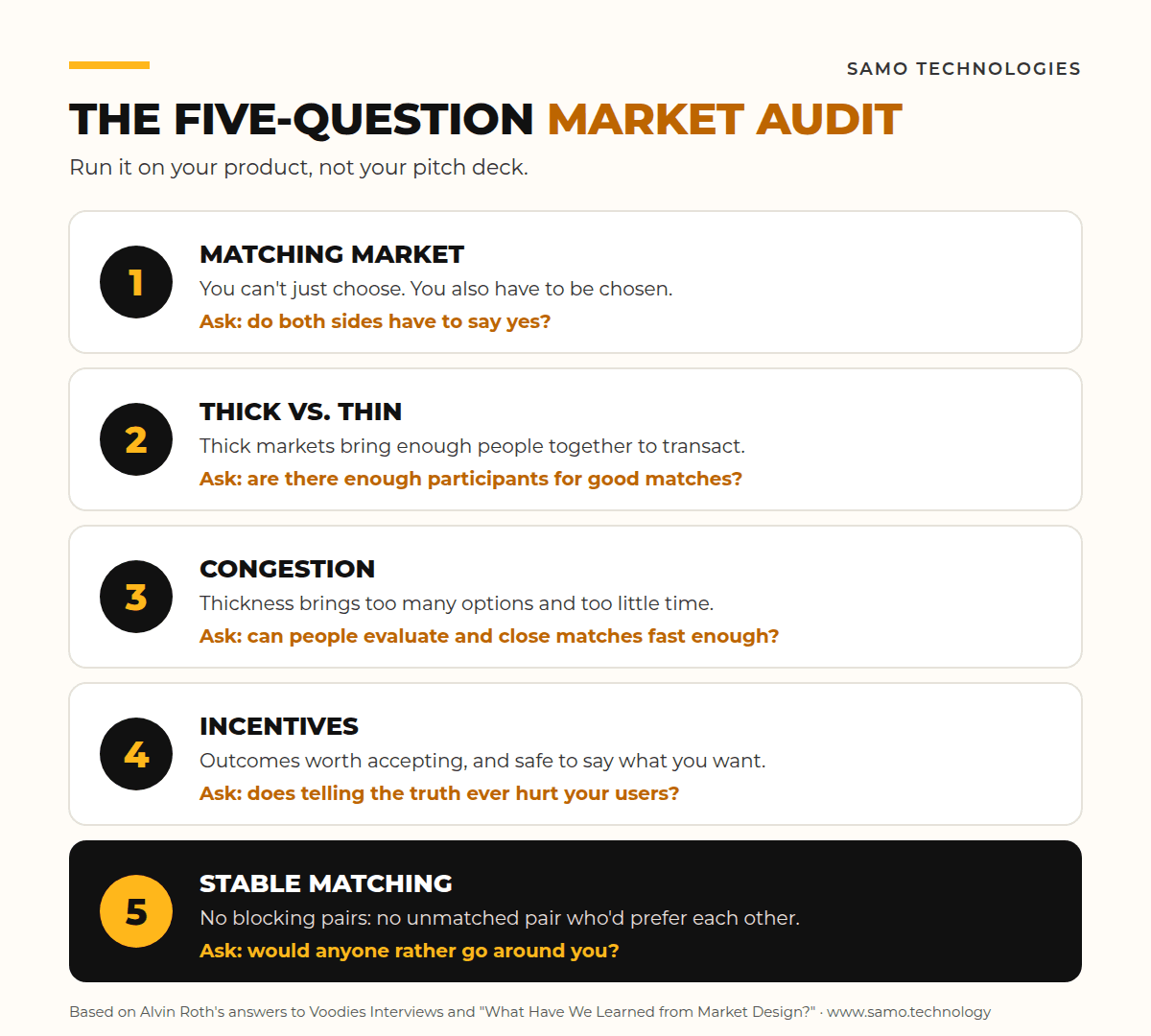
The five questions from the interview, turned into an audit you can run on your own product. Based on Alvin Roth's answers and his essay "What Have We Learned from Market Design?"
1. Is your startup a matching market?
Roth's answer: "A matching market is a market where you can't just choose what you want, even if you can afford it. You also have to be chosen." His example is a job: "You can't just go work for Google. You have to be hired" (Voodies Interviews).
That describes more of startup life than most founders realize:
- Hiring. The best engineers are choosing you as much as you are choosing them.
- Fundraising. You can't simply pick the investor you want. The investor has to pick you back.
- Two-sided products. Freelance platforms, rentals, dating apps, B2B procurement, and creator platforms all require both sides to say yes.
- Enterprise sales. A buyer selects a vendor, but a good vendor also qualifies out customers who will churn.
The founder takeaway: if both sides have to say yes, price alone will not clear your market. You need to collect preferences from both sides and design for mutual fit, not just discovery. A product that only shows supply to demand ignores half of the market.
2. Is your market thick enough?
Roth's answer: a thick marketplace "has a lot of people in it," and it "brings people together so that they can transact with each other" (Voodies Interviews). Founders call this liquidity.
In his essay What Have We Learned from Market Design?, Roth names thickness as the first job of any marketplace: it has to attract a large enough share of potential participants who are ready to transact. He also notes that thickness behaves like a public good. Everyone benefits from it, so it is hard to provide and easy to free-ride on.
Thin markets fail quietly. A buyer searches, finds three mediocre options, and leaves. A seller lists, gets no inquiries, and stops listing. Neither side tells you why.
The founder takeaway: shrink the market until it is thick. Launch in one city, one category, one customer profile, or one time window, and earn density before you expand. Track liquidity directly, for example, the share of listings or requests that turn into a completed match within a set time. A growing user count in a thin market is a vanity metric.
Also watch for unraveling. Roth describes markets where participants try to lock in deals earlier and earlier, before good information exists, as in medical residencies, law clerkships, and private equity recruiting (a16z crypto). If your users are making side deals before your marketplace opens, your market is losing thickness.
3. Will success congest your market?
This is where the interview gets interesting for growing startups. Roth: "When you have a thick market, sometimes it gets congested. There are lots of people who want to transact, and it's hard to figure out who you want to transact with, and it might take time to assess transactions and complete them" (Voodies Interviews).
In other words, solving question two creates question three. Roth's longer explanation in an a16z crypto interview offers three examples worth studying:
- Amazon would be unusable if you had to scroll its whole catalog alphabetically. Search is what decongests it.
- Early Airbnb made guests request a specific room, wait for the host, and often get rejected because someone else asked first, losing a day each time. Instant booking for trusted guests, and hiding listings once they are taken, removed much of that congestion. Roth argues those changes were necessary for Airbnb to compete with hotels.
- A telephone job market for psychologists where each reject-and-reoffer cycle took about six minutes, so only about ten could happen per hour. Each step was fast, but the chain was too slow for the whole market.
Congestion is also why Roth's committee introduced signaling in the economics job market. Each candidate can send a signal of particular interest to at most two employers, and the limit is what makes the signal credible (American Economic Association). Signals raised the probability of an interview from 25 to 32 percent relative to an unsignaled application to a comparable employer (American Economic Review).
The founder takeaway: design for the day you have too many options, not just too few. Good search and ranking, real-time availability, instant confirmation, and scarce "I'm really interested" signals all reduce wasted cycles. Scarcity matters. Roth notes that some medical specialties now allow thirty signals, which has started to act like a soft cap on applications rather than a meaningful expression of interest (a16z crypto).
This becomes more urgent as AI agents start applying, inquiring, and negotiating for people. When an extra application costs nothing, volume spikes and congestion follows. If you are building for agentic commerce, decide now how your system will separate real intent from noise.
4. Is it safe to tell your market the truth?
The fourth question was the hardest: individual rationality, incentive compatibility, and mechanism design. Roth's answer is the clearest version I have heard. "Individual rationality means the mechanism gives you an outcome that you're willing to accept. And incentive compatibility means it's safe for you to tell the mechanism what you like" (Voodies Interviews).
Translated for founders:
- Individual rationality: is participating better than staying away or transacting somewhere else? If not, people leave.
- Incentive compatibility: can people state their real preferences, prices, and constraints without being punished for honesty? If not, they game the system, and your data stops reflecting reality.
Roth's classic example comes from online auctions. eBay used a fixed end time, while Amazon auctions extended automatically until ten minutes passed without a bid. That one rule changed behavior. Bidders sniped far more on eBay, and experience made eBay bidders bid later but Amazon bidders bid earlier (Roth and Ockenfels, American Economic Review). In their eBay data, 37 percent of auctions had bids in the last minute (HBS Working Knowledge).
The lesson the authors draw is that the rule for ending an auction can affect behavior long before the end (Roth and Ockenfels). The same holds for your product. If your ranking rewards whoever responds first, people will optimize for speed over quality. If revealing a budget means paying more, buyers will hide it. If exploding offers punish candidates who take time to compare, your best candidates will find another process.
The founder takeaway: for every input you ask users for, ask whether telling the truth could hurt them. Then change the rule, not the user. Roth's medical match works because it is designed to make it safe for participants to submit their true preferences (Roth, Hahn Lecture).
5. Would anyone rather go around you?
The final question: what is a stable matching? Roth: "A stable matching is a matching that doesn't have any blocking pairs. In a labor market, a blocking pair is a firm and a worker who aren't matched to each other, who would prefer to be" (Voodies Interviews).
This is the idea Lloyd Shapley and David Gale formalized in the 1960s. Their deferred-acceptance algorithm always produces a stable matching, and Roth later built on it to redesign the doctor match and New York's school choice system (Nobel Prize). In New York, the old mail-based process left about thirty thousand students to be administratively assigned to schools they had not chosen. With a deferred-acceptance design, that fell to about three thousand (a16z crypto).
For a startup, blocking pairs have familiar names:
- Disintermediation: a client and a freelancer meet on your platform, then move off-platform. Roth notes that Airbnb is careful about how precisely it tells guests where a listing is, because it does not want to be worked around (a16z crypto).
- Churn and re-matching: a customer leaves for a competitor's provider they prefer and who prefers them.
- Poaching: in your own hiring, an engineer and a competitor who would rather be together will eventually find each other.
The founder takeaway: treat leakage as a design signal, not just a policy violation. If people keep going around you, your matching is unstable. Either the matches are not the best available, or your fees and rules cost more than the value you add. Anti-circumvention clauses help, but better matches and real ongoing value, such as payments, protection, reputation, and workflow, help more.
Roth's last answer is the real lesson
At the end of the clip, the interviewer asks for one piece of advice for anyone curious about economics. Roth's answer: "Look around them and see what's working well and what isn't working well. And what isn't working well can sometimes be fixed" (Voodies Interviews).
That is a founder's job description. Roth summarizes the general principle elsewhere: marketplaces have to make markets thick, then deal with the congestion thickness brings, then make participation safe, trustworthy, and reliable (a16z crypto). Most broken markets fail at one of those steps.
Run the five-question audit this week
Put these on a whiteboard with your team and answer them for your actual product, not your pitch deck.
| Question | Warning sign | What to try |
|---|---|---|
| Matching: do both sides have to choose? | You only collect preferences from one side | Capture fit criteria from both sides before showing matches |
| Thickness: enough participants for good matches? | Searches return few relevant results; listings go stale | Narrow geography, category, or timing until match rates rise |
| Congestion: can people evaluate and close fast enough? | Long response times, repeated rejections, ignored inboxes | Better ranking, live availability, instant confirmation, scarce interest signals |
| Incentives: safe to tell the truth, worth joining? | Users hide budgets, game rankings, or rush decisions | Change rules that punish honesty or reward gaming |
| Stability: would any pair rather go around you? | Off-platform deals, churn to rivals, poaching | Improve match quality and add value that continues after the match |
Sources: Voodies Interviews; Roth, What Have We Learned from Market Design?.
Then pick the one question where your answer is weakest and fix that first. If thickness is your problem, a faster booking flow will not help. If congestion is your problem, more acquisition spend can make it worse.
Further reading
- The Art of Designing Markets, Alvin Roth, Harvard Business Review
- What Have We Learned from Market Design?, Alvin Roth, NBER working paper
- Stable matching: Theory, evidence, and practical design, the Nobel committee's plain-language explainer
- Why markets fail and how to fix them, Roth on the a16z crypto show
- Roth's Market Design blog, updated almost daily
Building a marketplace, matching engine, or two-sided product, and want a second opinion on its rules? Talk with SAMO Technologies about the architecture behind it.