
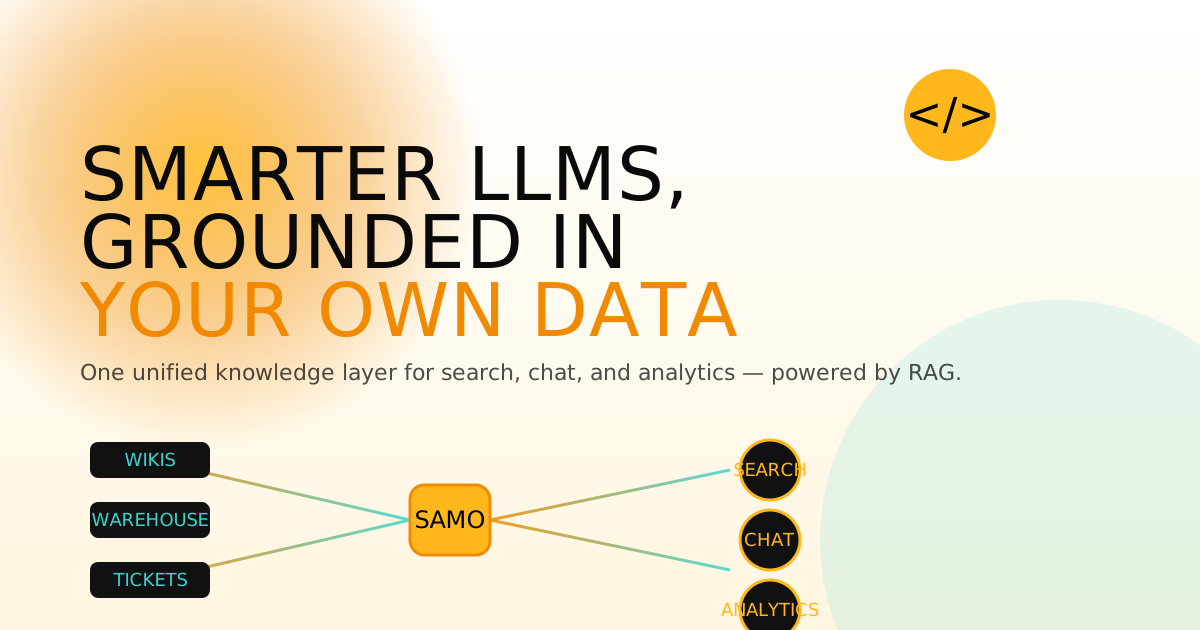
Large language models are only as useful as the context they receive. Public training data creates general capability. Your internal knowledge creates business-specific performance.
This guide explains how to implement retrieval-augmented generation (RAG) so LLM outputs are grounded in current, verifiable enterprise data rather than assumptions.
What is retrieval-augmented generation (RAG)?
Retrieval-augmented generation is a technique that connects a large language model to an external knowledge source at query time. Instead of relying only on what the model learned during training, RAG retrieves relevant, up-to-date passages from your data and feeds them to the model as context — so answers are grounded in what's true for your business right now.
RAG matters because foundational LLMs, despite training on trillions of tokens, do not know your customers, contracts, logs, or product history. They are pattern machines, not stewards of your institutional memory.
Why enterprise data quality determines AI quality
Inside your company you already have:
- Wikis, runbooks, SOPs, and policy documents
- Product specs, tickets, incidents, and postmortems
- Data warehouses, logs, and customer interaction histories
That corpus is your organizational body of knowledge. RAG is how you wire it into an LLM so responses reflect your operating reality.
RAG architecture components for production systems
Production RAG systems usually include these layers:
- Ingestion from source systems (SaaS tools, databases, files, event streams)
- Normalization and enrichment (metadata, entities, document structure)
- Chunking and indexing for lexical and semantic retrieval
- Retrieval orchestration (query rewriting, ranking, filtering)
- Context assembly and response generation with citations
- Evaluation, feedback loops, and governance controls
This is why AI implementation is data-centric: retrieval quality drives answer quality.
RAG vs fine-tuning: when to use each
- Use RAG when knowledge changes frequently and you need responses grounded in auditable sources
- Use fine-tuning when you need style, behavior, or domain adaptation that retrieval alone cannot provide
- Use both when you need strong domain behavior plus fresh factual grounding
In most enterprise workflows, RAG is the first step because data can be updated continuously without model retraining.
Common architecture pitfalls to avoid
Many teams accidentally create separate systems for search and chat retrieval, causing drift and duplicate operations.
Typical pitfalls include:
- Two sources of truth between search indexes and LLM retrieval stores
- Duplicated ingestion pipelines with overlapping transformations
- Weak metadata strategy that blocks reliable filtering and access control
- No retrieval evaluation harness to measure precision, recall, and hallucination rates
Designing for a shared knowledge layer and shared governance model reduces long-term complexity.
Data preparation checklist for better retrieval
Before tuning prompts, improve your data foundation:
- Add stable document IDs and ownership metadata
- Capture timestamps for freshness-aware retrieval
- Preserve section hierarchy so chunking respects semantic boundaries
- Tag sensitive fields for policy and role-based filtering
- Version critical documents and deprecate stale records
These steps usually improve retrieval relevance more than prompt edits alone.
Retrieval strategies that improve answer quality
High-performing RAG stacks combine multiple retrieval tactics:
- Hybrid retrieval: combine keyword and vector search for better recall
- Reranking: score candidate passages with a cross-encoder or task-specific ranker
- Query transformation: rewrite underspecified questions before retrieval
- Context compression: keep only evidence-bearing spans to reduce token waste
- Citation-first generation: require source-linked outputs for high-trust use cases
How to evaluate enterprise RAG performance
Use measurable criteria instead of subjective demos:
- Retrieval precision@k and recall@k on curated benchmark questions
- Groundedness score based on whether claims are supported by retrieved evidence
- Latency budget across retrieval, reranking, and generation
- Deflection and resolution impact for support and operations workflows
- Security compliance for access controls and redaction behavior
Evaluation should run continuously as schemas, documents, and user behavior evolve.
Implementation roadmap: from pilot to platform
- Pilot one workflow with clear ROI metrics (for example, support resolution time)
- Build shared ingestion and indexing that can serve multiple applications
- Add governance controls for permissions, PII handling, and audit trails
- Operationalize evaluation with recurring quality reports
- Scale across teams once reliability and ownership are clear
Where SAMO fits
If you want to implement this architecture without building all orchestration and governance pieces from scratch, SAMO can help.
SAMO works as an implementation partner to help teams:
- Design a production-ready RAG architecture for enterprise data
- Integrate retrieval workflows with your chosen model endpoints
- Implement evaluation, governance, and observability practices
- Scale from one use case to a shared AI knowledge platform
If you want a second opinion on your current stack or help implementing a production-grade rollout, talk to SAMO. For a strategic view of how this foundation supports agentic systems, read the Multi-Agent Architectures playbook.
Frequently asked questions
What is retrieval-augmented generation (RAG)?
RAG connects an LLM to an external knowledge source at query time, retrieving relevant, current passages from your data so answers are grounded in your business reality instead of only training data.
Do I need a separate vector database for every RAG project?
Not always. Many teams can start with hybrid retrieval over existing search infrastructure and add dedicated vector infrastructure only when scale, latency, or recall needs justify it.
How is RAG different from fine-tuning?
RAG injects external context at query time, while fine-tuning changes model weights. RAG is usually faster to update as knowledge changes because you update data pipelines and retrieval logic instead of retraining the model.
Which LLMs can be used with a RAG architecture?
Most modern endpoints can use RAG context, including Amazon Bedrock models, OpenAI and Azure OpenAI models, Anthropic models, and self-hosted open-weight models.
What is a good first enterprise RAG use case?
Start with a high-volume, high-friction workflow such as support resolution, internal runbook search, or sales enablement where answer quality and time-to-response are measurable.
When should I work with an implementation partner for RAG?
An implementation partner is useful when you need to ship quickly with strong governance, security, and cross-system integration. SAMO can help design, deploy, and operationalize a production-grade RAG architecture.